
EN/
Through the methodology of the queer spheres, we will explore queerness in Prishtina. How can we map queerness in the city in order to reflect on the possibility for a queerer future? The media for the mapping can vary from a written piece like a poem or text, a drawing, a picture, a map, an architectural drawing, a story, a piece of music…
The workshop will be tutored by Alexander Auris a 2021 Future Architecture selected fellow.
All interested should send their short bio to workshops.kaf@gmail.com September the 11th. Because of covid-19 measures the number of participants is limited and all applicants will be asked for vaccination proof and wear masks during the workshop meetings.
Venue: Innovation Center Kosovo / Date: 15-18 September 2021 / Open to All!
AL/
Përmes metodologjisë së sferave queer, ne do të eksplorojmë queerness në Prishtinë. Si mund ta hartojmë queerness në qytet në mënyrë që të reflektojmë mbi mundësinë për një të ardhme më queer? Mediat për mapim mund të interpretohët si një pjesë e shkruar, një poezi ose tekst, një vizatim, një fotografi, një hartë, një vizatim arkitektonik, një histori, një pjesë muzikore…
Puntoria do të udhëhiqet nga Alexander Auris një nga arkitektët e përzgjedhur të Future Architecture Platform për vitin 2021.
Gjithë të inrteresuarit për pjesëmarrje në puntori duhet dërguar një bio të shkurt të tyre në workshops.kaf@gmail.com deri me 11 Shtator. Për shkak të masave anti covid-19 numri i pjesëmarrësve është i limituar dhe të gjithë aplikuesve do ju kërkohet dëshmia e vaksinimit dhe mbajtja e maskave gjatë takimeve të përbashkëta.
Vendi: Innovation Center Kosovo / Datat: 15-18 Shtator 2021 / E hapur për të gjithë!

KAF 2020
online workshop by urbanaarchitettura
3 – 13 October
There is a chandelier in every room
We live in an age of ruins. The ruins of the welfare state in its various ideological and geopolitical embodiments in the form of those institutions that have been carefully choreographed to shape modern territories of top-down, domesticated, collectivised life. From education to hospitality, confinement to mental treatment, their architectures have often been relocated, sent to exile, vacated, forgotten, repudiated, or simply left to their own destiny in a state of controlled decay. Yet they might still be a resource for reinventing modes of living together.
As opposed to market-driven neoliberal euphoria to reinvent these places – read: the cultural center, the luxury hotel, the creative hub, the innovation campus, etc. – these ruins raise the question: what to do, beyond their musealisation, or final commodification? But also beyond a nostalgic reiteration of past ideals of total (forced?) socialisation? We think that precisely in the ruin of an institution lies the prospect of a de-institutionalised idea of collectivity; the drawing of, in the words of Robin Evans, a new picture of the sociable as opposed to the socialised.
The Prishtina Public Archipelago is one example of a territory made of large cathedrals of publicness laying in wait for reappropriation. Using it as a case study, we want to pull together a twofold reflection on the meaning of publicness.
Firstly, we will engage with one specific component of the Prishtina Public Archipelago: the Grand Hotel Prishtina. The hotel stands as a paradigm of publicness in which the space of appearance is sparingly negotiated within a territory of rooms. Rather than magnifying the open-plan capacities of its communal spaces and atria, we will aim for a de-privatisation of its matrix of rooms.
Secondly, we will question the publicness of architectural education by experimenting with the very format of this online workshop. A constellation of 8 ‘isolated’ participants will produce a collective work by experiencing and enacting the propagation, articulation, and ramification of their own spheres of influence. From their home-base, each participant will take part in a relay design race, developing a time-limited task as an essential fragment of the collective work while at the same time defining the rules for the subsequent participant’s contribution.
The workshop will run 3-13 October, but the students will not be expected to work for the whole duration. Within this period each participant will be required to work for 3-4 days.
All interested must send by 25th September to institutesofcare@gmail.com, a portfolio of selected design work (max 5 pages) and a brief cover letter specifying:
I do like…
I am quick at…
I am good at…
(collage, line drawings, renderings, photographs, physical models, writing, directing movies…)
Also please specify what devices you have (laptop, desktop, A4 printer, A3 printer, scanner, good quality photo camera, etc.)
The selected 8 students will be notified by September 30th and they will receive a welcome package with instructions for the workshop.


Lecture + workshop about the climate and biodiverity emergency, architecture’s part in it and how YOU can get involved to make a difference.
Register here for the ACAN WORKSHOP on Eventbrite.
About the Event
ACAN formed in London over the summer of 2019, in this talk we will take you through how ACAN was conceived, founded and is expanding. We will explain the principles and activities fundamental to the network, talk through some of the actions we have taken and explain the changes we are trying to bring about. We will discuss how to build effective campaigns and make an inclusive network of engaged individuals working collaboratively to address the climate and biodiversity crises.
There will be a short Q&A session before we divide the audience into groups. With a facilitator from ACAN you will be asked to discuss what issues affect your region and areas of expertise, how these could be overcome and what would be needed to make changes for the better.
This will not be the a run of the mill lecture and audience participation will be vital! Don’t be afraid, we will create a fun, inclusive forum for people to speak their mind and meet others who share their concerns. The movement is building and we want you all to be a part of it.

EN/
The workshop consists of theoretical and practical knowledge exploring the City of Prishtina (20/80), with a focus on both aesthetic and spatial topics. Each day is divided into two parts: preparing for shooting, with spatial observations, location scouting, shooting tips and photo review. While the second part is the photo shooting itself; which will improve photographic and aesthetic skills, and it will help you formulate an analysis of the built environment. We will explore Prishtina as a playground of viewpoints, taking pictures around artificial lit places. From the center to the overlook site to the City. We will deal with topics related to spatial observation and to visual perception such as composition and color. But also with time, weather and location tools. Analyzing the many aspects that determine the choice of pictures.
Each participant is free to focus on a specific subject of interests. Eg. interaction between people-spaces-objects, sociological use of space, places/non-places, objects/buildings… Our background will be the lighting sources of Prishtina, such as infrastructure, domestic lightings, skyglow, advertising light boards. On the last day of the workshop, we will select and edit the best pictures, for a small presentation.
The aim of the workshop is to understand the dynamics of night photography in the urban landscape. The four days of exercises are meant for passionate of photography, spatial studies graduates and students, and from social science disciplines. Basic knowledge of photography not required, but familiarity with your own camera is much appreciated. We would like everyone to come with clear interests before the workshop starts. What do you want to map/ research/or photograph in the night of Prishtina?
Bring a digital camera (must have), also preferred are a notebook, tripod, a light torch, shutter release (or self-timer in camera), GPS/ paper maps/compass.
All interested must send a short cv (2 pages max in pdf) by the 29’th of June 2019 to workshops@kosovoarchitecture.com and/or workshops.kaf@gmail.com with the subject being “Mapping Prishtina’s Nightscape”

SH/
Punëtoria përbëhet nga eksplorimi i njohurive teorike dhe praktike për qytetin e Prishtinës (20/80), me fokus në temat estetike dhe hapësinore. Çdo ditë është e ndarë në dy pjesë: përgatitja për fotosesion, me vëzhgim hapësinor, këshilla të xhirimit dhe rishikim i fotografive. Ndërsa pjesa e dytë ka për qëllim vetë fotografimin; i cili do të përmirësojë aftësitë fotografike dhe estetike dhe do t’ju ndihmojë të formuloni një analizë të mjedisit të ndërtuar. Ne do ta ekspolorojmë Prishtinën me një pikëpamje si të një këndi lojrash, me fotosesione rreth vendeve me ndriçim artificial. Duke filluar nga qendra në zonën e daljes dhe në qytet. Do të merremi me tema që lidhen me vëzhgimin hapësinor dhe me perceptimin vizual siç është përbërja dhe ngjyra, por edhe me mjetet e kohës, të motit dhe të lokacionit, duke analizuar shumë aspekte që përcaktojnë zgjedhjen e fotografive.
Secili pjesëmarrës është i lirë të përqendrohet në një subjekt specifik të interesave, p.sh. ndërveprimi midis njerëzve-hapësirave-objekteve, përdorimit sociologjik të hapësirës, vendeve / jo-vendeve, objekteve / ndërtesave, etj. Sfondi do të jetë vetë burimi i ndriçimit të Prishtinës, siç janë infrastruktura, ndriçimi i brendshëm, qielli, dritareve e panove reklamuese, etj. Në ditën e fundit të punëtorisë do të përzgjedhen dhe modifikohen fotografitë më të mira, për një ekspozitë të vogël.
Qëllimi i punëtorisë është të kuptojmë dinamikën e fotografisë së natës në peizazhin urban. Punëtoria 4 ditësh është e planifikuar për adhuruesit e fotografisë, studentët dhe te diplomuarit e studimeve hapësinore e arkitekt si dhe ata nga disiplinat e shkencave shoqërore. Njohuri themelore e fotografisë nuk kërkohet, por njohja e aparatit është shumë e vlerësuar.
Të gjithë të interesuarit duhet të dërgojnë një CV të shkurtër (2 faqe max në pdf) deri më 29 Qershor 2019 në workshops@kosovoarchitecture.com dhe/ose workshops.kaf@gmail.com me subjekt të emailit “Mapping Prishtina’s Nightscape”

EN/
“The public realm encompasses more than the streets and sidewalks of the city. It entails the complete social and public experience of moving through a city, from the inside of a cafe to the pathways of a park or waterfront, and the shifting vantage points that knit streets, sidewalks, shops, facades, and buildings into the whole urban experience.”
“From the pedestrian’s perspective, the scale at which we can best judge the success of urban design, fine grained elements of buildings, streets, sidewalks, plantings, seating, lighting and other details help create an intimate human experience and contribute to the character and identity of a particular neighborhood.”
NYC Urban Design Principles
New York City is famous for some great public spaces, including the beloved Bryant Park, Central Park and now the High Line, to name just a few; but it has only recently discovered that it has a much more comprehensive public realm. Unlike cities in Europe, cities in America, including NYC, have until very recently viewed streets as places primarily for cars and private land primarily for private users. It was not until the Bloomberg administration, and its release of PlaNYCin 2007, that the city began to view itself differently, from the pedestrian point of view and as a city for people. Deriving public benefit from private development was now the primary challenge.
This workshop will share some lessons learned from the Bloomberg years, what worked, what didn’t and what can be applied to other cities around the world, including Prishtina. Focusing on Lakrishta, and the center, we will apply NYC’s urban design principles and protocol, including the sidewalk toolkit, to analyze one neighborhood in particular and come up with a variety of proposals to improve its public realm.
Requirements for participation are enthusiasm about the city and the built environment. Students and recent graduates from the fields of architecture, landscape architecture, urban design, as well as sociology, philosophy, or art are strongly encouraged to apply. Participants are expected to actively contribute to the workshop for its whole duration.
All interested must send a resume (max 2 pages in pdf preferred) to workshops.kaf@gmail.com or workshops@kosovoarchitecture.com by the 28th of June 2019, with “Reframing Public Realm” as the subject.
The workshop will be led by Jeffrey Shumaker, Former Chief Urban Designer, NYC.

SHQ/
“Sfera publike përfshin më shumë se rrugët dhe trotuaret e qytetit. Përfshin përvojën e plotë shoqërore dhe publike për të lëvizur nëpër një qytet, nga brenda në një kafene deri te shtigjet e një parku apo buze uji, si dhe pika te ndryshme të vështrimit që ndërtojnë rrugët, trotuaret, dyqanet, fasadat dhe ndërtesat në gjithë përjetimin urban.”
“Nga këndvështrimi i këmbësorëve, shkalla në të cilën ne mund të gjykojmë më së miri suksesin e dizajnit urban, elementët e ndërtesave, rrugët, trotuaret, gjelbërimi, ndriçimi dhe detaje të tjera ndihmojnë në krijimin e një përvoje intime njerëzore dhe kontribuojnë në karakterin dhe identitetin e një lagjeje të veçantë”.
Parimet e Dizajnit Urban të NYC
Qyteti i Nju Jorkut është i famshëm për hapësira të mëdha publike, duke përfshirë Bryant Park, Central Park dhe tani High Line në mes tjerash; por kohëve te fundit ka zbuluar se ka një sferë shumë më të plotë publike. Ndryshe nga qytetet në Evropë, qytetet në Amerikë, përfshirë NYC, deri vonë kanë parë rrugët kryesisht zona për makina dhe toka për përdoruesit privatë. Me administrimin e Bloomberg-ut dhe lirimin e PlaNYC-it në vitin 2007, fillohet dukshëm të vërehen ndryshimet në qytet, nga këndvështrimi i këmbësorëve dhe si një qytet i popullit. Arritja e përfitimit publik nga zhvillimi privat ishte sfida kryesore.
Kjo punëtori do të ndajë me pjesëmarrësit disa mësime të përfituara nga vitet e Bloomberg-ut, çfarë funksionoi e çfarë jo, si dhe çka mund të aplikohet në qytete të tjera anembanë botës, duke përfshirë Prishtinën. Duke u përqëndruar në Lakrishte dhe në qendrën e qytetit, ne do të aplikojmë parimet dhe protokollin e projektimit urban të NYC, duke përfshirë veglën e trotuareve, për të analizuar në veçanti një lagje dhe për të krijuar një sërë propozimesh për të përmirësuar fushën e saj publike.
Kërkesat për pjesëmarrje janë entuziazëm rreth qytetit dhe mjedisit të ndërtuar. Studentët dhe të diplomuarit e rinj nga fushat e arkitekturës, arkitekturës së peizazhit, dizajnit urban, sociologjisë, filozofisë ose artit inkurajohen fuqishëm të aplikojnë. Pjesëmarrësit pritet të kontribuojnë në mënyrë aktive në punëtori për tërë kohëzgjatjen e saj.
Të gjithë të interesuarit duhet të dërgojnë një CV (max 2 faqe në PDF ) në workshops.kaf@gmail.com ose/dhe workshops@kosovoarchitecture.com deri më 28 qershor 2019, me temë “Reframing Public Realm” si titull i emaillit.
Punëtoria do të udhëhiqet nga Jeffrey Shumaker, ish Kryeshef i Planifikimit Urban në New York.


EN/
1-5 July 2019
Prishtina offers a wide range of public space: The pedestrian friendly area in the city center bordered with shops and cafés; the neighborhoods of the Yugoslavian era with their landscaped surrounding including sport facilities and playgrounds. However, the newer settlements at the edge of town offer a different image. The open spaces of this “Parallel City” are often subordinated to motorized traffic, oblivious to site specificities or inhabitants needs and relying on mono-functionality.
The build environment defines who we are and we, as architects, carry a responsibility in promoting social equity. We will investigate through an intersectional lens how to create public space where people of different socio-cultural, ethnic, or cultural background feel equal and respected. Intersectionality acknowledges the fact that every individual is made of a set of physical and social stratifications: gender, age, abilities, nationality, religion, class, education, … This framework is especially helpful to recognize the needs of non-compliant bodies, minorities, and marginalized groups in the creation of the inclusive city.
We will first analyze the condition of the public spaces within Prishtina’s urban sprawl by using the method of the Nolli map, a detailed plan of Roma dating from the 18thcentury where the urban areas are represented as a network of spatial relations. We will yet invert the map in order to look at the city in negative. This methodology will help us to analyze the cityscape, address its shortcomings and identify its potentials. We will then create proposals for improved public space, inquiring how intersectionality can be applied to fulfill various goals: Accessibility for all, diversification of mobilities, enhancement of communities, improvement of ecological conditions and local climate amongst others.
Requirements for participation are enthusiasm about the city and the built environment. Students and fresh graduated from the fields of architecture, landscape architecture, urban design, as well as sociology, philosophy, or art are strongly encouraged to apply. Participants are expected to actively contribute to the workshop for its whole duration.
Although workshop material will be provided by KAF, it is require that you bring your laptop & feel free to bring any other tool you feel comfortable to work with.
All interested must send a resume of themself (max 2 pages in pdf preferred) to workshops.kaf@gmail.com or workshops@kosovoarchitecture.com by the 25th of June 2019. The workshop will be led by Celine Baumann.


EN/
Architecture for the Age of Austerity
CITY MADE BY EVERYONE
Workshop tutor: Ivan Kucina
3-4 July
This workshop will resume diverse proposals made in the specific participatory process applied to transform urban voids into shared spaces. The aim is to exercise citizens’ engagement in designing interventions in the city that will provide initial condition for everyone to meet, talk, work, relax, play and enjoy together.
Workshop participants that will be organized in small groups will create their proposals using smart phones or tablets, and following the process that combines elements of two product design methods such as User Centered Analysis and Participatory Action Research. Process includes questioning, group profile analysis, scripting, and making photomontage.
From Urban Voids to Shared Spaces
Urban voids appear everywhere in the cities at many levels, shapes and scales in both space and time. They emerge as unforeseen leftovers of an uneven urban growth. Voids encompass the whole spectrum of urban phenomena: between unused and multi-used space, informal and formal, generic and customized, vacant and full, provisional and lasting… They are the spaces in-between fulfilled individual desires, ambitions, territories and interests.
Transformations of urban voids into shared spaces lay claim on urban development as part of an ongoing process in which city making is shared between many different actors. Spaces that are created in such process should not seek to eliminate differences, but to understand how to maintain lively controversies instead of deadly conflicts, how to establish smart means for social exchange among the concurrent ways of living.
All interested must send a short cv to media@prishtinaarchitectureweek.com by 25th of June with a subject “City Made by Everyone”.
EN/
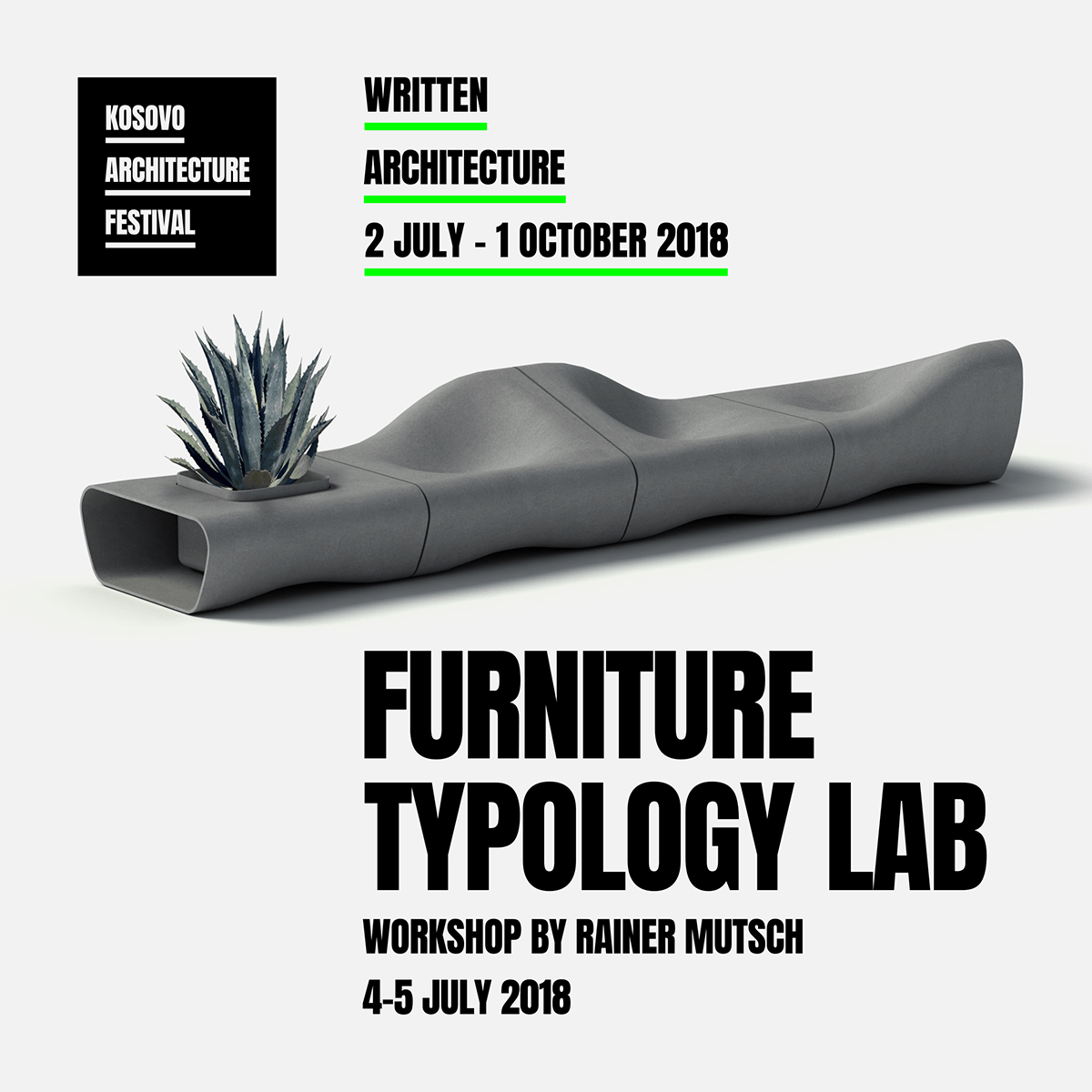
Furniture Typology Lab
workshop by Rainer Mutsch
4-5 July
This workshop aim’s to explore furniture design typologies by predefined abstract target groups. As a result the students will be introduced to industrial design and the creative process used by Rainer Mutsch.
All interested participants must send a short cv to media@prishtinaarchitectureweek.com with a subject “Furniture Lab” by the 28th of June.
AL/
Laboratori i Tipologjisë së Mobiljeve
punëtori nga Rainer Mutsch
4-5 korrik
Kjo punëtori synon të eksplorojë tipologjitë e dizajnit të mobiljeve sipas grupeve të paracaktuara të objektivave abstrakte. Si rezultat, studentët do të prezantohen me dizajnin industrial dhe procesin kreativ të përdorur nga Rainer Mutsch.
Të gjithë pjesëmarrësit e interesuar duhet të dërgojnë një CV të shkurtër në media@prishtinaarchitectureweek.com deri me datën 28 Qërshor, duke cekë “Furniture Lab” ne emailin e tyre.

EN/
Parallel Sprawl / Learning from Pristina
Most of the urban discussions that are taking place in Pristina today are around the large scale projects going on in the Lakrïshte district or the construction of a Great Mosque. While both developments are symbolically important, the former placing Kosovo in the map of global capital and later in the cosmology of global Islam, the real needs of Pristina citizens rely most probably in the improvement of the living conditions of its conspicuous suburbs.
This workshop addresses the study of urban sprawl and the possibility for its improvement with fresh eyes, retracting from the dogmatic view against suburbanisation that pervades in European academia. While acknowledging its issues and challenges, a new understanding of urban planning in a post-human condition, i.e. taking into account that we’re not any longer designing cities specifically for the human being but for all species on the planet, takes us to consider the advantages of those urban situations where the natural-artificial divide is less defined. The new set of options and constraints provided by new technologies and environmental challenges calls for a complete re-thinking of the way we inhabit the planet.
On the other hand, the specific recent history of Kosovo has created a suburban landscape that, while remaining problematic, reveals some of the possibilities that can be achieved when collectives and constituencies take themselves the challenge of building their dwellings in the lack of strong public, a scenario that might become more common in other European cities.
The aim of the workshop is to create a detailed analysis of the most characteristic typologies of suburban habitat encountered in 5 different neighbourhoods of Pristina, as well as the uses of its public spaces strictly by using tools specific to the architectural profession (drawing, collage) and others (photography, film, story-telling). The work will continue with the proposal a series of quick actions or urban recipes that could cheaply improve the living conditions immediately after the workshop ends. Finally, the students will be asked to create a speculative scenario that helps bring together the communities around a shared vision for their future.
WORKSHOP LEADERS
Ivan Blasi – Mies van der Rohe Foundation
Agustín Casalia – KdM
Katarina Dacic – KdM
Valentin Kunik – KdM
Guillaume de Morsier – KdM
Charlotte Maltherre-Barthes – ETH Zürich
Ibai Rigby – urbanNext
WHEN
2 – 13 July 2018
WHERE
Kosovo Architecture Festival
Hakif Zejnullahu
S11 H1/4 Pristina
Kosovo
WHO CAN TAKE PART?
The Parallel Sprawl Summer School is open to young people worldwide, studying in the field of Architecture / Design / Urbanism.
LANGUAGE
English
DURATION
2 weeks
EQUIPMENT
Participants should bring their own lap-top computers. WLAN is freely available.
FEE INFO
Admitted international participants are asked to pay a contribution fee of EUR 150,- (incl. taxes) including a two-weeklong design studio, 10 lectures and studio material; snacks on site, a roundtrip trough Pristina, a goodbye party and a Diploma for each attending student.
Travel expenses, accommodation, local transportation, meals and extra studio material are not included in the fee.
The payment of the fee is a condition for admission to Summer School.
APPLICATION
To apply for the Summer School please send an e-mail with your name, affiliation, country from which you will be traveling as well as a short portfolio and CV as one single Pdf of max. 10 MB to ibai@parallel-sprawl.org
The 20 participants will be contacted via e-mail until 26th of June 2018 and will receive further instructions to complete their registration. Contribution fees for admitted international participants are of EUR 150 to be paid within the deadline of 1st July 2018.
The applicants must guarantee their presence during the full program unfolding from 2nd to 13th July.
APPLICATION DEADLINE
18th June 2018


EN/
The spread of digital technology and social network interactions have transformed the recording and accumulation of images in a collective and daily activity. The potential of archiving videos and visual images has seen the emergence of non-institutional practices and as well contemporary discussions related to image, open source, collectivity, and forensics. Publishing architecture has stopped to be the terrain of canonical experts, which hardly react to the current state of the art and the myriad nuances of architectural practices nowadays.
The Workshop ‘A Thousand of Fragile Archives’ will reflect on the kind of the information we share, and the value given to the data we finally keep and guard. Attendees are asked to bring five JPEG images and their corresponded captions, with the solely condition of being what they consider their most valuable archives, in order to build a collective portrait of architecture and design examples corresponding to Kosovo and the rest of Balkan region.
The Workshop will reflect on the ephemerality of the devices and formats we use to keep information, and the tools we rely on to reproduce it. Images can be owned by the workshop attendees or correspond to some other person or institution, irrespective of its rights of reproduction. The workshop working tool will have an active agency in intervening and modifying the result, which can take the form of a printed or digital format, perpetuating the fragility of its nature.
-Attendees are encouraged to bring their laptops with the following working material: 5 jpeg images of architectural places, pieces or related knowledge.
-5 corresponding captions in TXT format
Working tool / Publish or Perish tool developed by Publishing Lab (Silvio Lorusso and Stef Kors) for DONE-Foto Colectania.
All interested must send a short cv with their contacts as well as any articles they have written on architecture by the 25th of June to media@prishtinaarchitectureweek.com with the subject “A thousand of fragile archives”.
The working language of the workshop will be english so a good command of the language is required.
About DPR-Barcelona
dpr-barcelona is an architectural research practice and independent publishing house based in Barcelona, founded by Ethel Baraona Pohl and César Reyes Nájera, dealing with three main lines: publishing, criticism and curating. Their work explore how architecture as discipline reacts in the intersection with politics, technology, economy and social issues. Their research and theoretical work is linked to leading publications in architectural discourse and their writing appears in Open Source Architecture(Thames and
Hudson, 2015), The Form of Form(Lars Muller, 2016), Together! The New Architecture of the Collective(Ruby Press, 2017), Architecture is All Over(Columbia Books of Architecture, 2017), Inéditos 2017(La Casa Encendida, 2017), Harvard Design Magazine, ARQ, and Volume, among others. Curators of the third Think Space program with the theme ‘Money’; they have also curated (together with Pelin Tan) the exhibition ‘Adhocracy ATHENS’ at the Onassis Cultural Centre, 2015, winner of the ADI Culture Award 2016. They have lectured and participated on international events and academic institutions, including KTH School of Architecture in Stockholm, EBABX Fine Arts School of Bordeaux, Sheffield Hallam University in UK, the Summer Pavilion of Serpentine Gallery in London, the Venice Architecture Biennale, [AUTONOMA]. Towards the Collective City in Athens, Akademie der Künste in Berlin, among many others. They have directed Foros 2017, the architecture lecture series of the UIC Barcelona School of Architecture.
dpr-barcelona understands the book as a space of encounters where the act of publishing becomes a form of cultural, social, and intellectual resistance. For that reason, their publications, both digital and printed, transcend the boundaries of conventional publications, approaching to those which are probably the titles of architecture in the future, exploring the limits between printed matters and new media, transforming traditional publishing practice into a live exchange of knowledge. Their [net]work is a real hub linking several publications and actors on architecture and theory. Since 2016, dpr-barcelonais platform member of Future Architecture, the first pan-European platform of architecture museums, festivals and producers.
